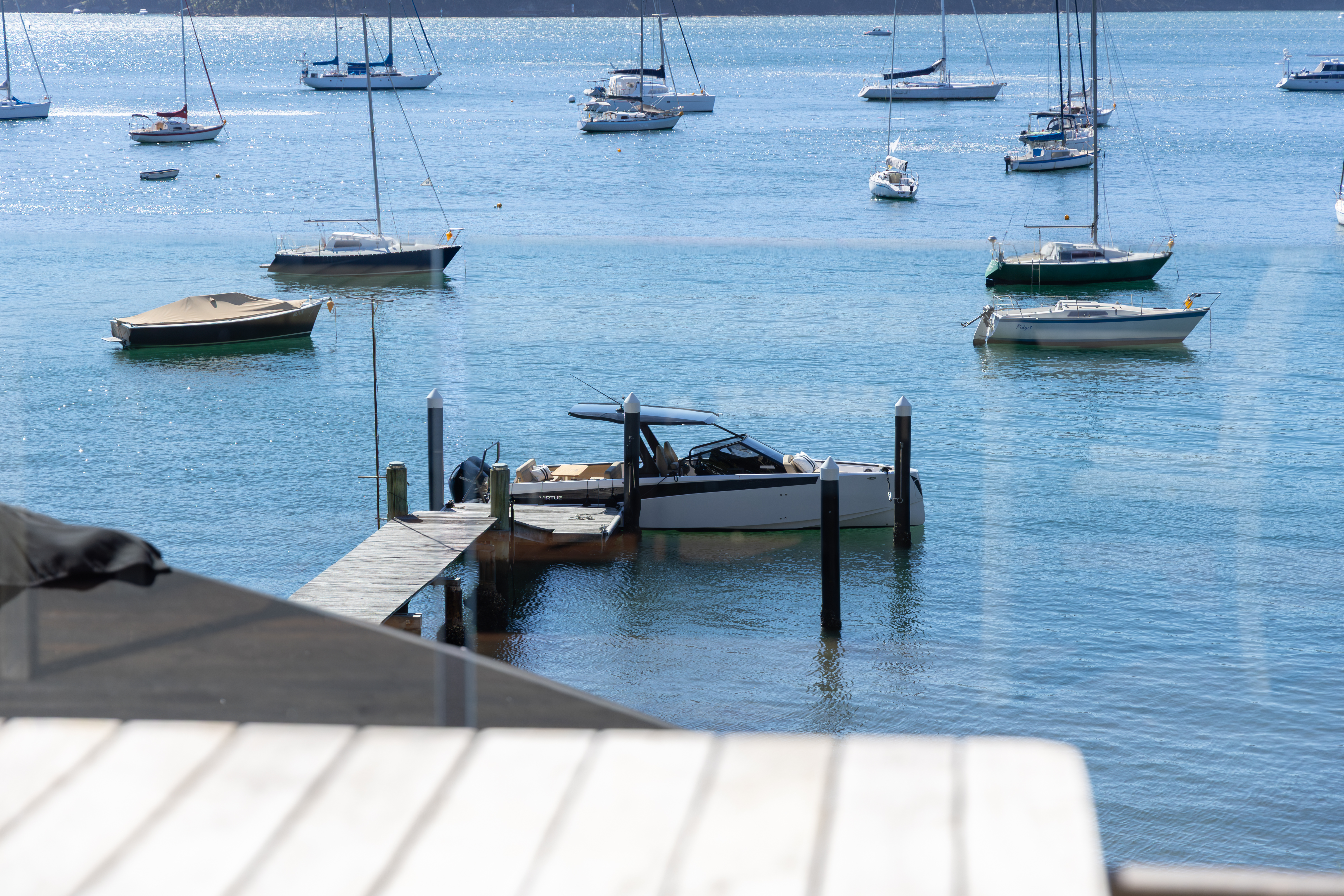

Ask what defines a Virtue Yachts V33 and most people point at the terraces or the styling. The more important answer is underneath. Every V33 — Open, Top and Cabin — runs on a Petestep hull, a Swedish-designed, twin-stepped running surface. It is the least visible part of the boat and the part that most shapes how it drives.
What a Petestep hull is
A conventional planing hull is a more or less continuous V. It works, but it pays for lift with two things: wetted surface, which creates drag, and spray, which it throws outward along the topsides. The Petestep geometry changes both. Steps in the running surface reduce how much of the hull stays in the water at speed, and specially shaped deflectors redirect the spray downward and aft — back into the wake — instead of letting it climb the hull sides.
The design intent follows directly: less drag for a given speed, a drier boat, and a running surface that stays composed when the water is not. It is patented, it is engineered in Sweden, and it is the reason the V33's performance figures are achievable with outboard power rather than something larger and heavier.
It is worth separating the two mechanisms, because they do different jobs. The steps are about efficiency — reducing wetted surface once the boat is up and running. The deflectors are about comfort and dryness — managing the water the hull has already displaced. Marketing tends to blur them into one promise; from the helm they feel like two distinct benefits.
What you notice from the helm
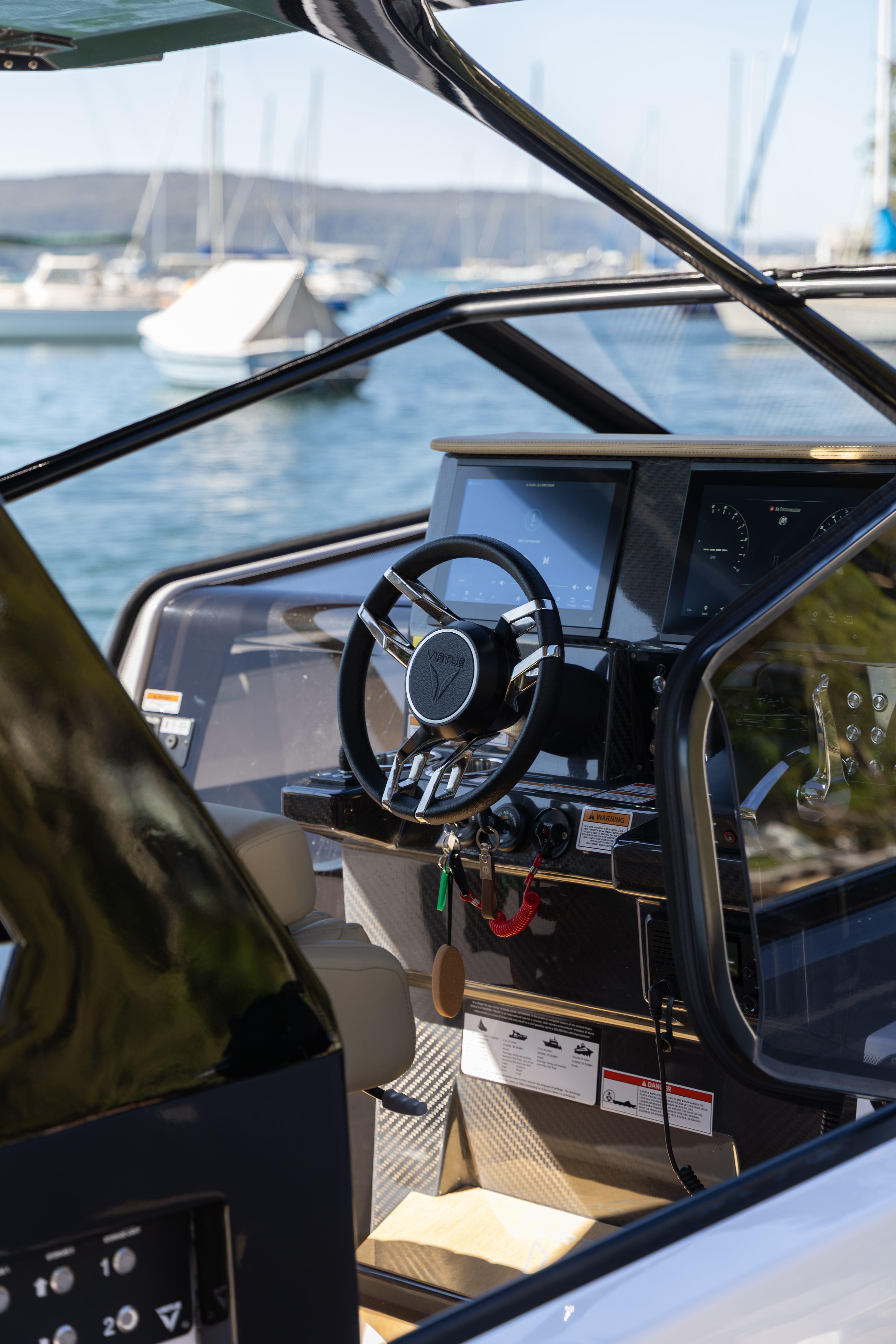
Translated into driving terms, three things follow from the geometry. First, the windscreen stays clearer: spray that would normally sheet across the boat is thrown down and away, so visibility in a quartering sea is better than the conditions suggest it should be. Second, the ride reads softer in chop, because energy that would go into throwing water around is managed by the deflectors instead. Third, the boat holds its speed through lumpy water without demanding constant throttle attention — the hull is doing more of the work.
To be clear about what this is: it is the design intent of the hull form, consistent with how the manufacturer specifies it and how the V33 presents on the water. It is not the result of instrumented testing we have conducted ourselves.
Where the claims need nuance
Hull design is one variable among several. Load, sea state, engine setup and driving style all influence how any boat rides and what it burns, and a stepped hull is not exempt. Efficiency figures in particular deserve care: whether a Petestep hull saves fuel, and how much, depends entirely on what you compare it against and under what test conditions. You will see percentage claims attached to this technology; we do not repeat them, because we cannot verify the basis.
It is also fair to say what a stepped hull does not do. It does not make a badly balanced boat good, and it does not remove the need for seamanship. What it does is give a well-sorted boat a measurably better starting point — and in the V33's case, the rest of the boat is sorted well enough to take advantage of it.
Not tied to one kind of power
Because the hull's work is hydrodynamic rather than mechanical, it is indifferent to what turns the propellers. The standard V33 pairs it with Mercury Verado outboards; the Virtue Yachts V10e T-Top runs the same running surface with EVOY electric propulsion. The ride and dryness arguments apply either way — which is part of why the platform, rather than any single engine package, is the thing worth understanding.
What to look for on a test drive
Hull claims are best assessed from the helm, and a short run tells you most of what matters if you know what to watch. Cross a wake or a ferry wash at an angle rather than head-on, and watch the windscreen rather than the horizon: where the spray goes is the whole story. Then hold a steady throttle through lumpy water and notice how much correction the boat asks for. A hull doing its job feels unremarkable — that is the point.
Bring guests and put them where they would actually sit, not beside the driver. Ride quality is a hospitality question as much as a technical one, and the answer is different at the aft lounger than at the helm.
Why it suits Australian water
Much Australian dayboating happens in exactly the conditions this hull addresses: harbour and coastal chop, afternoon sea breezes, and runs long enough that ride quality decides whether guests want to come back. A hull that stays dry and settled in those conditions is not a brochure point here — it is the difference between a boat that gets used and one that gets admired at the marina.
The same thinking scales up: Studio Delta / Petestep provides the naval architecture for the Virtue Yachts V45 Hard Top. And it was the hull, more than anything else, behind the V10's Best for Performance nomination at the Best of Boats Award 2024.